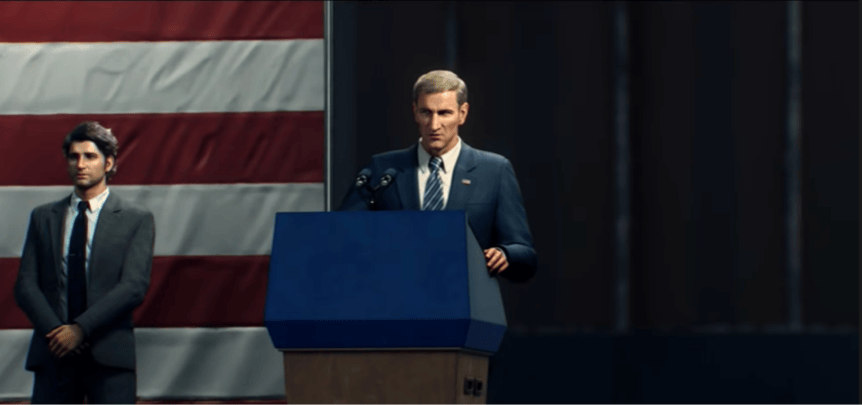
Only a few days before the release of Resident Evil: Infinite Darkness, a controversy has been going about Netflix having asked reviewers “not to talk about politics” in their reviews of the series. This is not the kind of subject I intended to approach so soon here, but I feel compelled to talk about it because we historians hear that phrase all the time and this is extremely tiring.
Let’s be simple: how can we not to talk about politics when Infinite Darkness clearly alludes to real events of our contemporaneity, and very serious events such as wars and political decisions? And what’s more: did Netflix really think that, when accepting to publish such material, they wouldn’t be subject to political commentary?
So far, Capcom didn’t want to comment on the matter. I suppose the reason is to avoid conflict with Netflix, but I have my reasons to believe that it wasn’t out of fear. After all, it’s not the first time Resident Evil has tackled sensitive issues. In fact, since the beginning, the franchise has been about illegal and unethical operations carried out by a multinational company involved with governments, including that of…the United States.
Umbrella produced weapons for the US government to use in wars. And, in real life, the United States is the biggest producer and exporter of armaments on the entire planet, as well as the country with the greatest military power. I have already written a whole text about this on the blog.
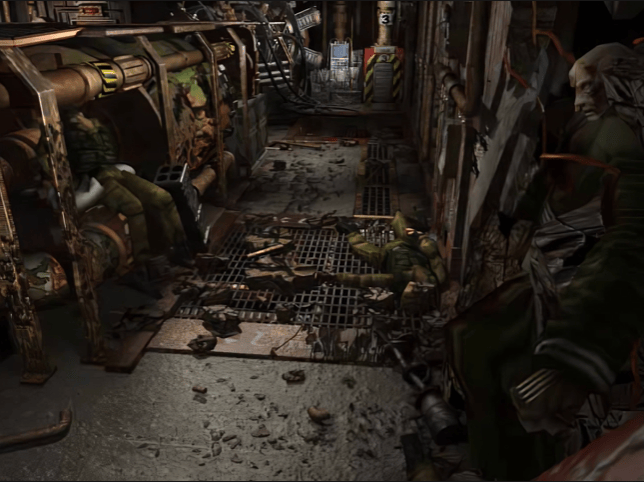
The remains of the battle between the American army and Umbrella’s T-103 Tyrants in the fight related to the G-virus. Resident Evil 3: Nemesis, 1999.
And now let us remember something VERY important: Resident Evil was created by Japanese men. And the United States… threw TWO ATOMIC BOMBS on Japan at the end of World War II. It is true that the Japanese were allies of the Nazis, however, the bombing caused the deaths of tens of thousands of people instantly, most of whom were civilians and there were even prisoners of war. Just think of the impact of the destruction of Raccoon City. This is still deeply strong and highly traumatizing in the memory of the Japanese population, even when there is a critical attitude towards Japan’s conduct in the war.
Do you understand where I’m going? Japan may even have a friendship with the US today, but the Japanese haven’t forgotten the destructive potential that US military power has. And I didn’t even mention yet that RE was created just a few years after the end of the Cold War, in which the greatest fear was the disruption of a war that would destroy the planet. This might have played an important role in creating Resident Evil.
Books, comics, films and video games are made by human beings who put their feelings, life stories, values and worldviews in these cultural products. And this is independent of the intentionality because we are unable to detach ourselves from our historical, social, and cultural context even when we want to be impartial.
Right here on the blog. You can certainly visualize some politics. I try to make it as light and as informative as possible, because this place is my therapy and not an activism blog. But it is impossible not to touch some sensitive and often controversial issues, because they are an inherent part of our history, our society and also of the society that exists in the Resident Evil universe.
That’s why I always bring my bibliographic references. It’s a matter of being transparent, of showing where I got the information that I carefully researched to write the texts. Transparency is better than pretending a neutrality that doesn’t exist, because this is very often a sign of dishonesty. Most times those who accuse us as historians of being biased are hiding their own bias under the mask of impartiality, and that’s where fake news and similar come from.
So, as much as one insists that it’s not, Resident Evil is indeed a bit political, albeit relatively subtly. It is not exactly a game that intends to make great explicit social critiques, but it does carry a critical tone to certain phenomena and figures in our society, and this since its early stages. I’ll leave this link with a great Twitter thread on the subject and here on the blog there will always be historical articles that will inevitably end up falling into these topics.
So, from my point of view, Netflix was extremely naive to think that Infinite Darkness wouldn’t bring about political discussions, because Resident Evil has always had this approach.
Also, it’s rather curious that when Damnation was available on the platform, it appeared in the political films category. Why a film that has fraud in a Russian-based government (because the Eastern Slav Republic seems to me probably a territory that has separated from Russia) can be political and the one that shows a fraud in the United States government cannot?

Anyway, Netflix’s attitude is quite weird, since it has plenty of movies, series and documentaries much more political than Resident Evil: Infinite Darkness. Maybe it’s because of the niche of a popular game never before associated with politics (but actually yes) and possibly because Paul Anderson’s films, which were RE’s most famous film media, didn’t go that way.
Nevertheless, if Netflix accepted the series, they should face the consequences, because for Capcom it must be just another day at the office.
I don’t think Resident Evil has to be a political agenda platform. It probably never will, however, we cannot ever disregard that it is a story that does have its parallels with very dark things from our reality. And it is precisely this realistic aspect that differentiated it from other games and made Resident Evil the great reference of survival horror.
If you want to ignore the political aspects and just have fun, it’s up to you. It’s valid and everyone does it to disconnect. We just can’t pretend the real world isn’t full of these problems, and that it is where we actually live.

